 Subscribe
Activity theory, like distributed cognition, is another theoretical framework that is familiar to many of us, and has been used in HCI research. The more I read about activity theory, the more I feel it is addressing very similar issues as distributed cognition, but from a different perspective with different emphases. Distributed cognition has its roots in anthropology (Hutchins is an anthropologist, and was a student of Roy D’andrade). Activity theory can be traced back to Lev Vygotsky, who is the father of cultural-historical psychology.
There are several key concepts in activity theory. In this post I focus on mediation and its implications on understanding visualization as a cognitive and cultural artifact.
No one will deny that visualization is essentially a tool for accomplishing something: the purpose of visualization is insights, not pretty pictures. It thus makes sense to claim that the utility and role of visualization cannot be discussed abstractly independent of its context, but can only be evaluated and understood with respect to human user(s) and a specific purpose.
This observation is inline with the basic tenet of activity theory, which argues that there is an irreducible tension between cultural tools (visualization), and agents’ active uses of them. Sounds reasonable and perhaps a little too obvious? In actual research practices however we are often more than happy to choose to focus either on visualizations alone or on human agents only. The current disciplinary setup (InfoVis vs. Cog Sci) makes such approaches natural, but adherents of activity theory will argue that these efforts are essentially misguided. Focusing on visualization alone implies that human action is causally determined by the environment, while focusing on human alone risks attributing too much cognitive abilities to humans in isolation.
The unit of analysis is thus not visualization, or human, but an irreducible whole (sounds similar to DCog?) called mediation. The Vygotsky triangle (figure below) depicts such a unit of analysis:

And here’s my adaptation for InfoVis
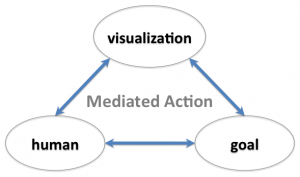
With this tri-dimensional, non-linear theoretical construct, how do we go about systematically analyzing it? I believe this is an important problem that future InfoVis/Visual Analytics research needs to tackle. One way to proceed is to think metaphorically in terms of conventional data analysis techniques: If we have this multifaceted and multidimensional dataset called mediation, we’ll need some tools to look at it from different angles, at different levels of abstraction, and perhaps slice and dice it! Coming up next, I’ll discuss the concept of three levels of activity, which provides a different angle to look at mediation. Eventually, we may want to introduce and synthesize conceptual and methodological findings from a broader range of disciplines to fully handle this complex beast called mediation.